


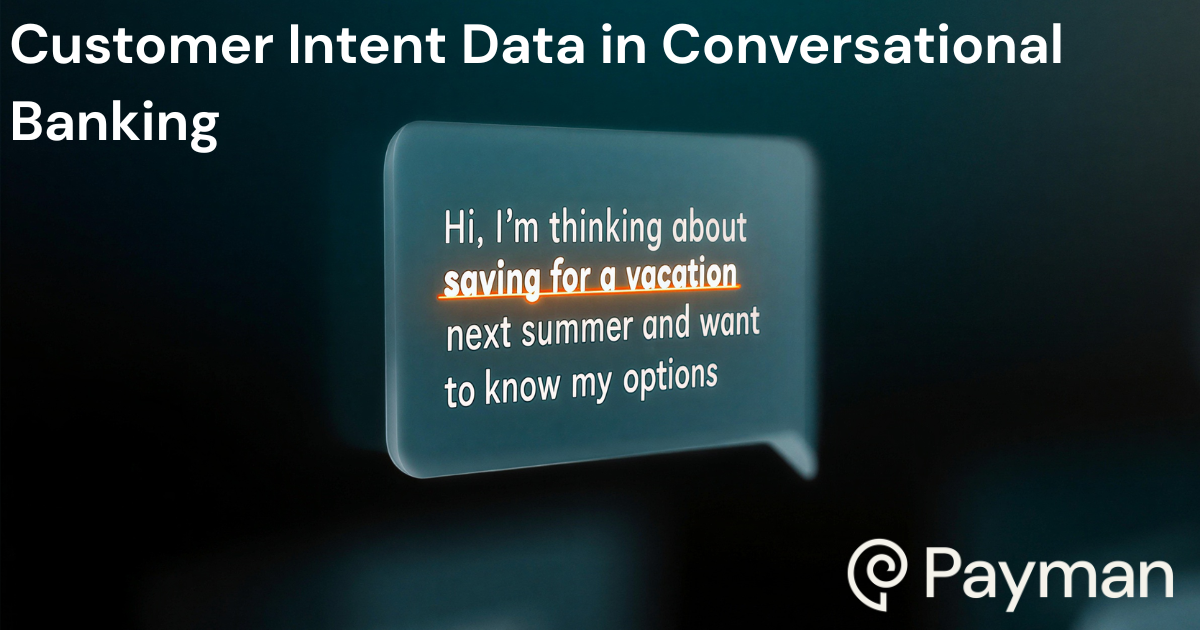
Every time a customer says "move enough to cover rent" or "I'm worried about overdraft," they're revealing something a transaction record never captures. That context, the why behind the request, is customer intent data. It's the difference between knowing what happened and understanding what your customer actually needs.
Here's how intent data works in conversational banking, how AI extracts it from natural language interactions, and how banks can use it to personalize offers, detect flight risk early, and turn conversations into growth opportunities.
What is customer intent data in conversational banking?
When banks analyze conversational data, they're turning unstructured chats and calls into something actionable.
Intent data captures the why behind a request. When someone says "I need to transfer money before my rent is due Friday," the intent isn't just "transfer." It's managing a deadline, dealing with cash flow pressure, and working within a specific timing window.
Transaction data only records what happened. It shows a $1,200 transfer on Tuesday. It doesn't tell you the customer was stressed about making rent or waiting on a paycheck to clear.
- Intent data: The motivation or context behind a request (e.g., "covering rent before payday")
- Transaction data: The outcome that occurred (e.g., $1,200 moved from checking to external account)
Why transaction data alone leaves banks blind
Transaction records show outcomes but miss the context that drives customer behavior. When a customer's spending shifts from one retailer category to another with an overall dip in volume, the transaction log captures the change. But it can't tell you whether that customer moved, started budgeting, lost a job, or just changed habits. The data shows movement. Intent tells you what it means.
Without intent, banks can't tell if a balance inquiry signals routine checking or anxiety about an upcoming bill. They can't distinguish a customer who's financially healthy from one showing early signs of hardship.
This is where conversational banking changes the equation. When a customer interacts through natural language, they naturally share context that structured forms and menu trees strip away. The bank that captures and acts on that context sees a fundamentally different picture of its customers.
How we extract intent from banking conversations
Our agent doesn't treat every customer message like a one off request. When someone asks, "Can I hold off on that payment until my direct deposit hits?" the agent remembers context like their balance, upcoming obligations, payment history, usual timing, and what they were trying to accomplish in previous sessions.
That memory lets it understand the real need behind the words, then propose the right next step while still validating every action against the bank's policies, controls, and approval rules before anything executes.
Types of intent signals captured in banking interactions
Agentic banking surfaces several categories of intent signals, each with distinct business applications.
Financial goals and life events
Customers reveal long-term priorities through conversation: saving for a home, planning a wedding, preparing for retirement. A customer mentioning "we're trying to save for a down payment" is telling you something transaction data never would, and it's an opening to serve them better with relevant products at exactly the right time.
Cash flow stress and friction points
Requests like "Can I move this after my paycheck hits?" or "I'm worried about overdraft" signal financial pressure. Transaction data might show the same transfer either way, but intent data reveals the stress behind it. Banks that catch these signals early can offer payment flexibility or hardship programs before a missed payment happens, not after.
Cross sell and product interest signals
Questions about loan rates, credit options, or investment products indicate active interest. Unlike demographic targeting, intent signals identify customers who are already thinking about a product category. The difference between "people aged 30-40 who might want a mortgage" and "a customer who just told you they're house hunting" is enormous.
Service and resolution intent
Customers seeking to dispute charges, understand fees, or change account settings reveal service friction. Tracking patterns in resolution intent helps identify systemic issues before they become widespread complaints.
Use cases: from intent signal to business outcome
Intent data translates into concrete business outcomes when connected to action.
Personalized product offers. A customer mentioning "saving for a house" triggers relevant mortgage or savings product recommendations. The timing aligns with customer readiness rather than arbitrary campaign schedules.
Proactive risk and hardship detection. Cash-flow stress signals enable early intervention. Banks can offer payment flexibility or hardship programs before a customer misses a payment or closes an account. The signal comes from conversation, not from a missed payment that's already happened.
Customer retention and loyalty. Understanding life events and goals allows banks to engage meaningfully. A customer planning a move might benefit from address change reminders and local branch information. Small touches that demonstrate you were actually listening.
Contact center and channel optimization. Intent analysis identifies common friction points and resolution patterns. Banks can improve routing, reduce handle times, and refine self-service options based on actual customer needs rather than assumptions.
Analyzing intent data compliantly in regulated environments
Intent analysis in banking requires auditability and explainability. Every customer request gets logged verbatim, AI reasoning gets captured, policy checks get timestamped, and execution traces answer "why did this happen?" in seconds rather than days.
Compliance alignment spans KYC, BSA, and AML requirements. The key is maintaining immutable records that connect customer words to system actions through every step:
- Request capture: Customer's exact words logged
- AI reasoning trace: How the system interpreted intent
- Policy validation: Rules applied before any action
- Execution timestamp: When and what was authorized
Audit readiness isn't just about logging. It's about reconstructing the full decision chain from customer request to completed action within minutes. This is table stakes for any bank deploying conversational AI, and it's something we've built into our platform from the ground up.
Turning intent data into executed banking actions
Here's the gap most AI banking tools don't close: they surface intent but then hand customers off to forms, menus, or human agents to finish the job. The customer tells the AI what they want. The AI understands. And then... the customer gets redirected to do it themselves.
The difference between insight and action is the difference between knowing a customer wants to move money before rent and actually completing that transfer with a confirmation.
This is what agentic banking solves. The AI interprets the request, validates against policies, executes the transaction, and captures the intent signal in a single flow. The customer gets a completed outcome. The bank gets actionable intelligence. No handoff. No form. No friction.
It's the approach we've built at Payman: intent capture and transaction execution happen together, because separating them defeats the purpose of understanding intent in the first place.
Download the Agentic Banking Guide →
The future of intent-driven conversational banking
Intent data will become the primary layer banks use to understand customer relationships. Transactions show behavior. Intent reveals motivation. And when intent connects directly to execution, the entire customer experience changes.
Banks that move first on intent driven, agentic banking will set the standard. When customers experience banking that understands why they're asking and completes the task in the same interaction, going back to menu trees and form fills won't feel like an option.
The question isn't whether this shift is coming. It's whether your bank will be the one customers compare everyone else to.