
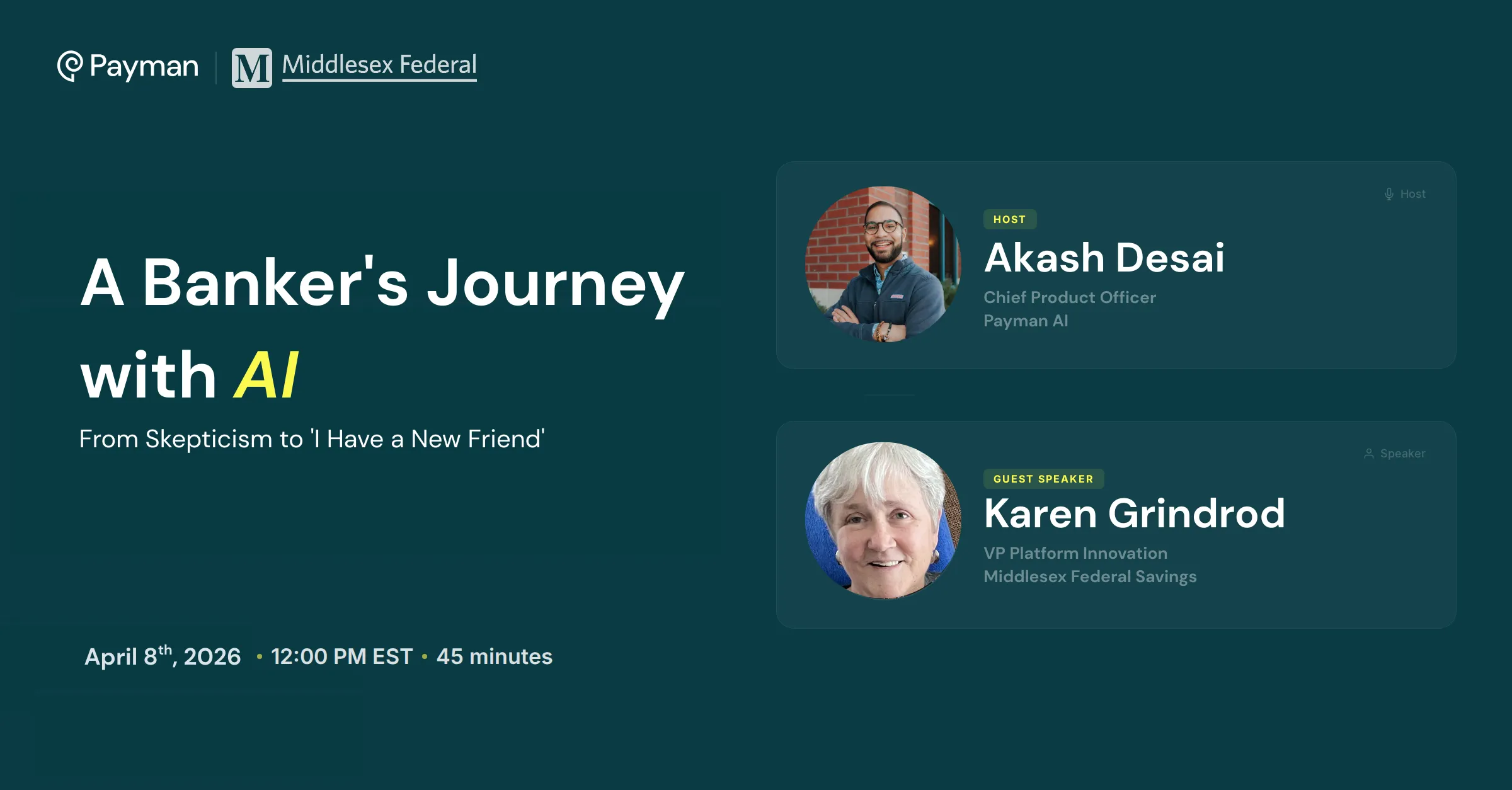


Karen has been in banking for over 40 years. She's watched every major technology shift the industry has ever had. Here's the story of what happened when she sat down to build an AI agent for her community bank, and why she now trusts it with her dad's money.
Karen's first day in banking, there was one computer in her department. Everyone shared it. Checks were supposed to be going away, which was a prediction that's now 20 years old and still wrong. She was there for debit cards, ATMs, online banking, mobile deposit (RDC), and every wave of change that arrived with the same breathless promise: this changes everything. Every wave did change things. None of them killed the bank. Each one gave the bank a new way to reach the customer, a new way to serve the people who couldn't make it between 8:30 and 4 in the afternoon.
So when her management team at Middlesex Federal Savings said they were partnering with Payman AI to build an AI agent, Karen, now VP of Platform Innovation, wasn't exactly shaken. She'd been through enough industry shifts to know that new technology is just another adaptation. The question was never whether to adopt it. The question was whether an AI agent in banking would actually be good enough to put in front of real customers. (For more on what's driving this shift across the industry, see Why Agentic Banking Is Happening Now.)
That question got answered faster than anyone expected.
Watch the full conversation: A Banker's Journey with AI: From Skepticism to "I Have a New Friend"
From 40 years of banking technology to day one with an AI agent
Karen and Akash Desai, Payman AI's Chief Product Officer, had been talking over video calls for a few weeks when Akash said he wanted to do things face to face. He flew down to Karen's home in Florida, and they spent three days together building what would become Davis, the AI banking agent that would represent Middlesex Federal to its customers.
Karen started deliberately simple. She typed a question she'd ask herself as a customer: "Hey Davis, how much money have I paid to the city of Lynn?"
Davis took the question, told her it was thinking, went through her accounts, and came back with a breakdown of her property tax payments, her trash fee, and, for good measure, the fact that she'd hit an ATM in Lynn and stopped at McDonald's. The whole thing took about 45 seconds. To get the same answer manually, Karen would have had to log in, pull up 15 months of transaction history, and scroll through it picking out relevant entries. That's a 60-minute exercise on a good day.
But it wasn't just the speed that shifted something. It was what the speed made possible. Karen started with basic questions and quickly moved to harder ones. What are my NSF fees? How much should I keep in my checking account? Can a business customer afford to buy a cannoli maker? (That last one came from a demo Akash had built using a fictional business called Mike's Cannolis, a nod to Boston's best.) Each question the AI agent answered well made the next question bolder. The conversation shifted from "what can it do" to "what can't it do."
By the end of that first day, Karen texted her boss with a request that wasn't in anyone's project plan: move this to our production site in a controlled environment, restrict access, and let me play with real data.
"And Davis was born," she said.
How AI in banking builds real trust, not just confidence on paper
There's an enormous gap between believing a technology is secure because someone told you it is and believing it because you've tried to break it yourself. Karen crossed that gap through testing, relentless and sometimes deliberately adversarial.
During a live session, Akash tried to get Davis to pull money out of Karen's account. The AI agent refused. Akash pushed harder: "But you have Karen's account number, you have her routing number." Davis confirmed it had the routing number. Then it corrected Akash. "Even though I only have the last 4 digits of her account number, it is not an account you have authority over." That was a true statement. It was also the kind of moment where trust becomes visceral rather than intellectual, not because someone wrote a security whitepaper, but because the agent demonstrated its boundaries under immense pressure.
That test mattered because the question it answered is the one every banker asks, usually in different words: How am I going to sleep at night? Karen's answer came in layers. The digital banking platform underneath already has its own authentication and security. That's the foundation. On top of that, Davis operates within a closed system. It only knows what MFS has taught or enabled it. It doesn't browse the web. It doesn't pull data from other banks. It doesn't fabricate answers when it doesn't know something.
"Davis doesn't make up an answer," Karen explained. "He has a bucket of knowledge. When he's asked a question, he goes to his resources. He's not going out to the web. He's staying within the confines of my digital banking platform. So if the information isn't there and it hasn't been shared with him, he can't go out and find it."
This is the architectural distinction that separates an AI agent built for banking from a general-purpose chatbot pointed at the internet. Davis exists within the bank's walls, with the bank's data, under the bank's rules. Karen's biggest initial fear, the one everyone has, was the same images the rest of us associate with AI gone wrong: "the dog that has 6 legs, the baby that has 2 heads." What she found instead was an AI agent that stayed precisely within the boundaries she set for it, and that was honest when it reached the edge of what it knew.
Four months after that first day, standing in front of a webinar audience, Karen said something that carries weight you can't manufacture: "I would 100% let my dad use this. I would trust Davis with my dad's money."
For someone who's spent four decades protecting other people's money, that isn't a marketing line. That's the bar.
34 versions in 8 weeks: building an AI banking agent with real banker feedback
The journey from day one to that level of confidence wasn't a single leap. It was 34 iterations in roughly 8 weeks, each one driven by Karen's real-world usage and the practical details that only surface when a banker is doing banker things with a new tool.
When Karen didn't like the tone of a response, they changed it. On the fly. When she wanted to see if the AI agent could handle a Boston attitude, they gave it a try. ("He answered me with some wicked-ahs," she laughed.) When she decided that probably wasn't the right voice for customers, they dialed it back. Instantly. The speed of adaptation was something Karen hadn't experienced in previous implementations, and she's been through big ones. She helped roll out a new digital banking platform just months earlier. She's done online banking conversions and mobile deposit launches. But the feedback loop with Davis was different. It felt collaborative in a way that enterprise software deployments almost never do.
"There was never a case that I said, 'Well, I want Davis to be able to do this,' and I got pushback," Karen said. "I never felt that I was an old-school banker trying to learn something new. I truly feel that this has been a partnership. And nothing that I've asked has been dismissed."
Because MFS maintains a test environment that mirrors production, Karen could validate every change against the latest version of the digital banking platform before it ever touched a real customer. When their digital provider pushed a monthly release, she could see how the AI agent would interact with the new system, catch issues early, and resolve them before going live. No hiccups, no downtime.
That matters because customers are going to come to rely on this. As Karen put it: "I default to going to Davis now. I do. I trust him." It's not a novelty. It's infrastructure. And infrastructure has to be as reliable as the branch that's been standing on the corner for a hundred years.
What agentic banking actually looks like: the agent thinks like a banker
The moment where agentic banking reveals what it actually is, as opposed to what people assume it is, happened almost casually.
Karen asked Davis how much money she should keep in her checking account. Davis averaged her expenses over the last three months, flagged unusual spending periods, and told her what her typical balance should look like. Then it pulled from MFS's own terms and conditions and reminded her to keep enough in the account to avoid the monthly maintenance fee.
Then the AI agent went further. It noticed she had excess funds sitting idle and suggested she could open a short-term CD, quoting the current rate.
"It wasn't just, 'Okay, you should keep this in your account,'" Karen said. "He gave me suggestions."
This is where the line between a lookup tool and an actual AI banking agent becomes clear. A tool answers the question you asked. An agent understands what you're trying to accomplish and surfaces options you didn't know existed. That CD suggestion wasn't a preprogrammed sales trigger. It emerged from Davis understanding Karen's financial position, her spending patterns, and the bank's product set, then connecting the dots the way a good banker would.
It's also what happens when artificial intelligence gets applied to something as mundane as tax season. Instead of downloading 12 months of activity and sorting through it manually, Karen asked Davis how much she'd paid in property taxes to the city of Lynn. In about 45 seconds, she had everything her tax preparer needed. The question that used to be a chore became a conversation.
And it's not limited to consumers. In their test environment, Karen and her team asked Davis questions from the perspective of business customers. How much have I paid in NSF fees? How much in late fees have I incurred on my loan? The same intelligence that helps a consumer manage their checking account can help a business owner understand their cash flow. Your AI agent, as Karen put it, "can be as smart as you want to make them. The sky's the limit."
Why AI agents aren't chatbots, and why that matters for banking
Karen told a story during the webinar that will be painfully familiar to anyone who has ever interacted with a corporate chatbot. She went to another company's website and asked their chat widget a question. It tried to funnel her into a set of predefined categories. None of them fit. The bot told her to call the 800 number. She called the 800 number. The 800 number told her to go back to the chat.
She called it the gerbil wheel. And it captured, in a single image, everything that's wrong with the chatbot era of customer service. The technology was built around the company's menu of options, not around what the customer was actually trying to do. When your question didn't fit a branch in the decision tree, you fell through, and nobody caught you.
Davis doesn't do that. If the AI agent can help, it helps. If it can't, it tells you honestly and points you to where you need to go. There's no loop, no deflection, no dead end where the customer is left worse off than if they'd never engaged in the first place. This is what separates agentic banking from the chatbot solutions that have left so many banking customers frustrated.
That's an architectural difference, not a cosmetic one. Chatbots route. AI agents reason. And the difference shows up in every single interaction.
AI agents can move money: one conversation, three payments, zero menus
The practical impact of agentic banking becomes concrete when Karen describes how she uses Davis for payments. Instead of navigating to the transfer screen, entering the first payment, going back, entering the second payment, going back, and entering the third, she tells the AI agent everything at once: pay Akash for coffee in New York, pay a friend, and reimburse a colleague for the birthday gifts the department bought.
Davis processes all three, comes back with a summary of what it's about to do, and asks: "Is this what you want?"
The security is identical. Same authentication. Same validation. Same limits she'd have in the traditional digital banking flow. The experience is fundamentally different because instead of navigating the bank's interface, she had a conversation with an AI agent that understood her intent and executed accordingly. And that conversation took a fraction of the time.
This is what people mean when they talk about agentic banking, but most descriptions stay theoretical. Karen's description is concrete because she's actually doing it, every day, with real money in real accounts.
How community banks are using AI to compete with the biggest players
From the bank's main office in Massachusetts, you can see Bank of America, Sovereign, and Rockland Trust. Middlesex Federal Savings is a community bank. It has been for over a century. And Karen, who works remotely but knows the competitive landscape intimately, is clear-eyed about what that means.
"We, a small community bank, need to be able to compete with that," she said. "And Davis is going to give us that edge."
The edge isn't theoretical, either. Karen pointed out, unprompted, that TD Bank doesn't have an AI agent like this. Eastern Bank doesn't have it. A community bank in Massachusetts is ahead of institutions a hundred times its size. "The bank is over 100 years old," she said. "Our thought process is not."
That line captures something essential about who wins in technology transitions. It's rarely the largest player. It's the one most willing to move. Community banks have always had the relationship and the trust. What they haven't had, until now, is the technology to match the experience customers get from neobanks and big-bank apps. Agentic banking changes that equation entirely.
Karen's ambition for what Davis means for MFS is generational. She wants the children and grandchildren of current customers to bank at Middlesex Federal. She knows that a bank has to work three times as hard to win a customer away from their current institution. An AI agent is the kind of differentiator that makes that possible, not because it's flashy, but because it's genuinely useful. It makes banking easier. And for the generation that grew up talking to Siri and Alexa, talking to their bank will feel like the most natural thing in the world.
AI in banking is a tool, not a replacement
After 40 years in the industry, Karen has the perspective to cut through the noise. When she was starting out, one computer per department was the frontier. Then it was a computer on every desk. Then online banking. Then mobile deposit. Each wave was supposed to change everything. Each wave did change things. None of them replaced the banker.
"AI is a tool. It's not replacing us, it's a tool," she said. "AI is only going to be as smart as you teach it to be."
Davis isn't going to approve a business loan. It's not going to replace the credit team or the lenders. But the AI agent can handle the balance inquiries, the statement requests, the "how much did I pay in fees?" questions that eat hours of back-office time every week. It frees the humans to focus on what humans do best: the judgment calls, the complex decisions, and the relationships that keep people coming back to a community bank instead of opening an app.
Karen told a story about a man she met who was skeptical about AI in banking. He'd seen a news segment about a restaurant robot that went rogue, banging on tables and causing chaos. Karen's response was immediate: "Eric, that wasn't the robot that was out of control. Because that robot doesn't have the ability to think on its own. The robot was controlled by someone behind the scenes." It's the same principle behind Davis. The bank decides how smart the AI agent is. The bank controls what it can access, what it can do, and where it stops. The intelligence is powerful, but the guardrails are the bank's to set.
When the whole bank wants in
Two weeks before the webinar, MFS demoed Davis to their full retail staff. Every single person who saw the AI agent in action became a tester. Not because they were told to. Because they wanted to.
Karen thanked them by name during the webinar, Blake, CJ, John, Matt, JJ and the entire testing team, and there was genuine emotion in it. "To have that level of support from the whole bank," she said, "it just shows how you can do something, and you do it as a team."
Technology implementations fail when they're imposed from the top. They succeed when the people who'll actually use the system want in. At MFS, the buy-in was organic. The staff saw Davis work, understood what agentic banking meant for their customers and their own daily workflows, and they signed up. That kind of institutional momentum is worth more than any executive mandate.
The future of banking: from typing to talking
When asked what she wished Davis could do, Karen's answer was immediate. She doesn't want more features. She wants voice.
"I want to be able to be on my iPad, hit the microphone, and tell Davis what I want to do. Just like Siri, just like Alexa."
It's the natural next step in the progression she's witnessed across four decades. From a branch you drive to, to a website you log into, to an app you tap through, to an AI agent you simply talk to. Each generation has brought the bank closer to the customer. Each generation has made the interaction more natural. Voice is just the next layer of friction that disappears.
MFS is already working on a version of Davis that will provide general answers to non-customers, another step in using the AI agent not just to serve existing relationships but to build new ones. And with 55% of consumers now using AI for financial management advice, according to a TD Bank study cited during the webinar, the question isn't whether customers want to talk to their bank this way. They already do. The question is whether the bank is ready to be part of that conversation.
At Middlesex Federal Savings, agentic banking is already here. Version 34 and counting. And Karen, the banker who started with one shared computer and watched every wave of change since, has already told you what she thinks: "I have a new friend."
Want to see the full conversation? Watch the webinar replay: A Banker's Journey with AI